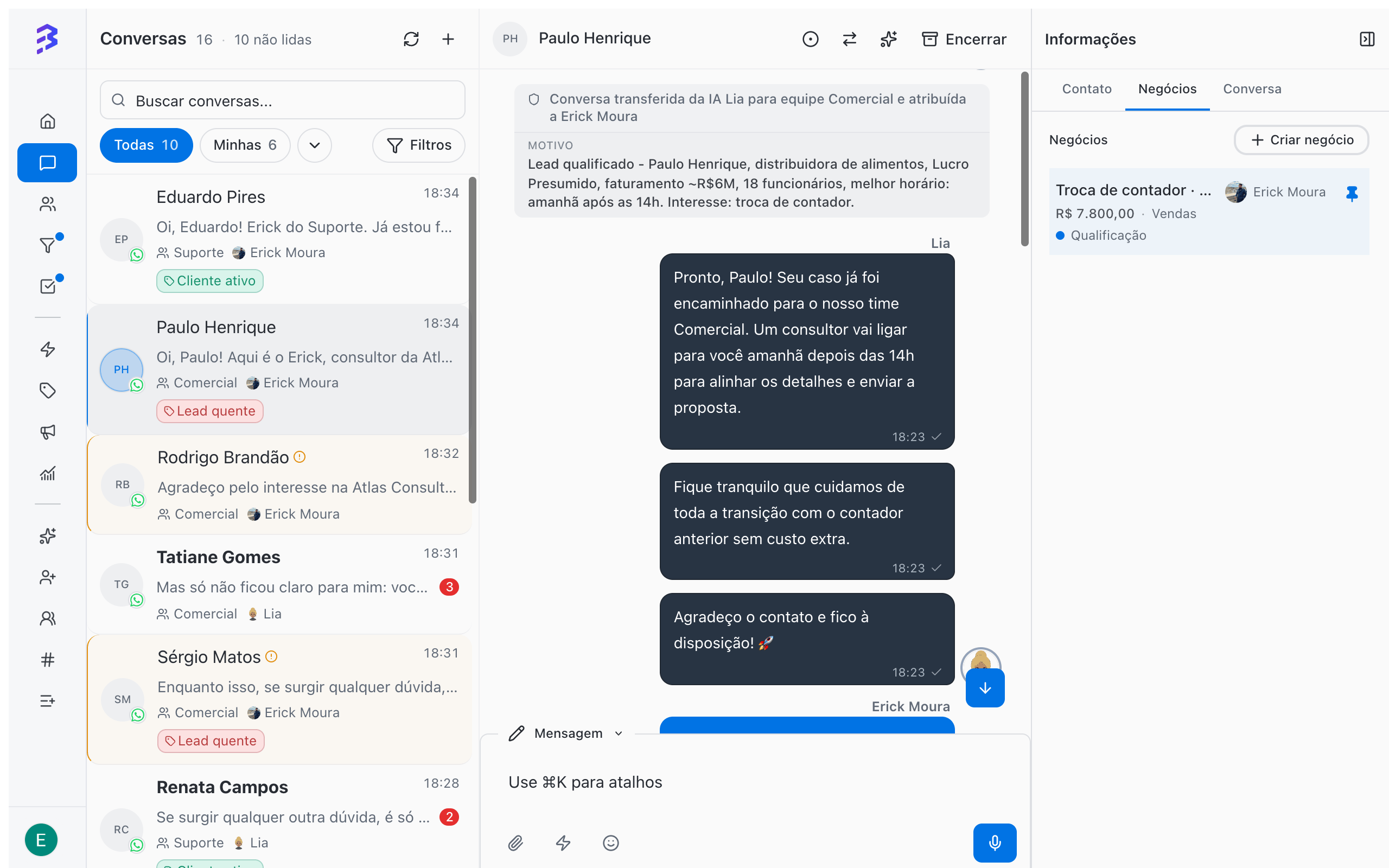
The platform objects
Contact
The person or company you talk to. Stores phone, WhatsApp, email, Instagram username, tags, additional fields, owners and the full history.
Conversation
One service interaction about one subject, on one channel. It has a team, an assignee, a status and a protocol, and it is closed when the subject is resolved.
Deal
An opportunity or an ongoing process with that contact. It has a value, an owner, a stage, tasks and a history of moves.
Pipeline
The sequence of stages a deal goes through. It fits any process: sales, support, onboarding, collections, legal cases.
Team
Groups members, channels and Pipelines. Defines conversation distribution, SLA, calendar, closure rules and the satisfaction survey.
Channel
The entry point for conversations: a WhatsApp number, an Instagram account or a Webchat widget. Each channel has a default team and, if you want, an AI agent.
Conversations and deals measure different things
BluBash uses two yardsticks. Mixing them up is the main cause of confusing reports.The conversation lifecycle
Hybrid service: AI and team in the same conversation
Each conversation can have an AI agent, a team member or both. In the conversation list, a sparkle icon next to the name indicates Hybrid conversation (user + AI). While the AI agent is handling the conversation, the message box shows AI Agent Active and the Take Over button. When the team member is done, they can use Handoff to AI to hand the conversation back. Hybrid service →Three rules that prevent rework
Derive the deal instead of moving it to another Pipeline
Derive the deal instead of moving it to another Pipeline
When a process ends in one area and starts in another (for example, the sale closes and the project begins), mark the deal as won and let derivation create a new deal in the next area’s Pipeline. The first area’s result stays on record and the history remains available. Dragging the deal to another Pipeline removes that result from the reports.Set up derivation between Pipelines →
Lost with a reason, never a discard stage
Lost with a reason, never a discard stage
“Unqualified lead” or “Not interested” are not stages. Mark the deal as lost and choose the reason. That way you know how many deals are lost for each reason.Won, lost and reasons →
One conversation is one subject
One conversation is one subject
Did you solve what the customer needed? Close the conversation. If they come back with another subject, a new conversation starts. This shows how many times each customer reached out and why, and keeps resolution time and SLA accurate.When and how to close a conversation →
AI from day one, with growing autonomy
The AI agent can serve customers from day one. What changes over time is how much it does on its own.1
Start: AI that answers and routes
The agent answers frequent questions, collects basic data, adds a summary note and transfers to the team. The team creates deals from the conversation.
2
Stable operation: AI that resolves
With training refined from real conversations, the agent starts closing routine conversations on its own with Allow closing conversation, and the team keeps what requires a decision.
3
Mature operation: integrated AI
With HTTP Request and Apps, the agent queries and updates external systems during the conversation, and derivation between Pipelines moves the customer from one area to the next automatically.
Track progress in the Conversations report: the Total conversations over time chart separates Unassigned, Human only, AI agents only and Hybrid (human + AI). The AI Analysis in the 360° View shows the quality of each conversation.
Next steps
Implementation guide
Set up your account in the right order.
FAQ
Common questions about AI, service, Pipelines and reports.